
Beyond admin costs: what is charity cost-effectiveness analysis?
Beyond admin costs: what is charity cost-effectiveness analysis?
Beyond admin costs: what is charity cost-effectiveness analysis?

Note: The research in this post was done by a human, not by AI. AI was used in some places to tidy up the writing.
When we see a social issue that moves us, our natural instinct is to respond with our hearts. We want to help, so we look for a charity that tells a compelling story, or we look at their financial statements to 'make sure their overhead or admin costs are low'. Well-intentioned, caring Hong Kong donors ask these suboptimal questions because they deeply care about making a difference.
However, behavioral research shows that our moral intuitions about charitable impact are frequently wrong. We often suffer from scope insensitivity—our brains struggle to emotionally grasp the difference between saving 10 lives and saving 10,000 lives; they both just feel like "doing good." Because our gut feelings cannot distinguish between an intervention that helps a handful of people and one that transforms an entire community, we need a more objective tool.
When we talk about assigning a cost to an outcome, some may instinctively recoil. But we must remember: the price of saving a life is not the same as the value of a life. Life is invaluable. It is precisely because we value human life immensely that we must look at the price of interventions, so that we can save as many people as possible with our finite resources.
Seeking to maximize measurable impact isn’t cold or clinical; it is a profound type of ambition for impact. It is the recognition that because our charitable resources are strictly limited, we have a responsibility to make them go as far as possible. Data is not a monarch; it is merely a guide, and while perfect data does not exist, striving for better data allows us to make far better-informed decisions than relying on gut feelings or overhead ratios alone.
In this article, we explore how leading international evaluators use Cost-Effectiveness Analysis (CEA) to bypass intuitive biases and uncover where our donations can do the most good.
The Reality of Giving: Impact is "Heavy-Tailed"
In many areas of life, we expect outcomes to follow a standard bell curve—where most charities produce average results, a few do slightly worse, and a few do slightly better. However, data in global health and development reveals that charitable impact is drastically heavy-tailed.
As highlighted by Toby Ord in “The Moral Imperative Towards Cost-Effectiveness”, economic evaluations from the World Bank’s Disease Control Priorities Project (DCP3) indicate that roughly 80% of the benefits are produced by the top 20% of interventions. The difference between an ordinary charity and a highly effective one isn't a minor 10% or 20% improvement; the most effective interventions are often 100x to 1,000x more impactful per dollar spent.
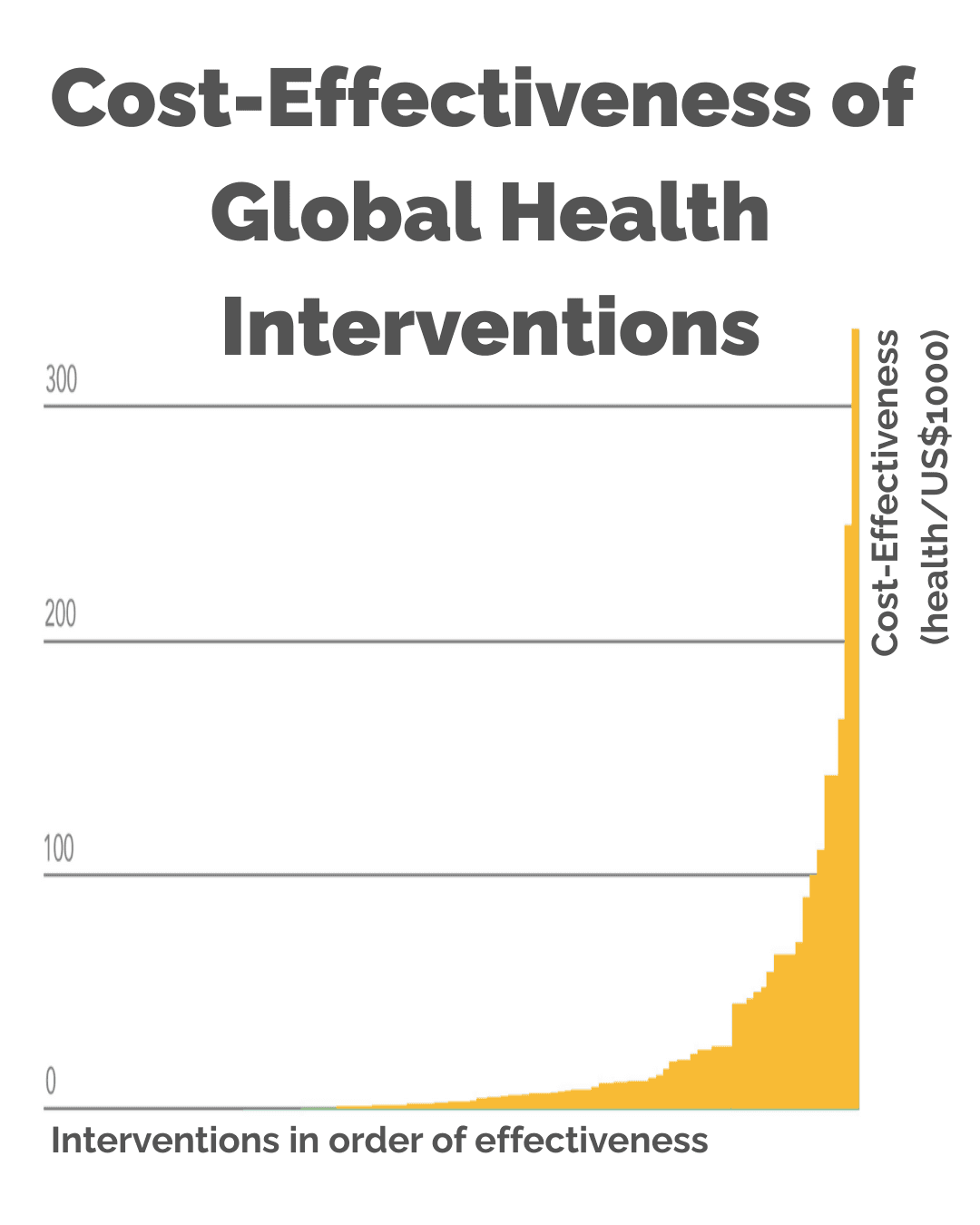
Cost-effectiveness of global health interventions (DCP3)
To find these hyper-impactful opportunities, impact-focused evaluators look at cost-effectiveness through a much wider lens than most people realize. When we talk about cost-effectiveness, we aren't just looking for cheap programmes; we seek to find interventions that are evidence-backed, with depth, durability, and scalability, amongst other features. That is fundamentally what true cost-effectiveness means.
Impact-Focused Charity Evaluation | Traditional Charity Evaluation |
Prioritise Causes: Uses structured frameworks like STN (Scale, Tractability, Neglectedness) to identify high-priority problem areas. | Focuses primarily on which cause area aligns with the giver’s personal or emotional focus. |
Evidence-Based: Focuses on highly effective interventions backed by a strong evidence base, such as Randomized Controlled Trials (RCTs). | Looks broadly at which charities happen to work in a specific cause area. |
Core outcome metrics: Measures what the program actually achieves and compares its cost-effectiveness against other programs. | Weighs easily obtainable metrics more heavily, such as overhead costs, accountability, and financial transparency. |
Depth of Investigation: Conducts deep, exhaustive investigations into a smaller number of highly promising programs. | Provides surface-level ratings for hundreds of charities to ensure they aren't fraudulent. |
Shifting Metrics: From DALYs to Moral Weights
To calculate "good per dollar" accurately, researchers have had to move beyond basic outputs (like the number of blankets distributed) to actual health and life outcomes.
A foundational metric used by global entities like the World Health Organization is the DALY (Disability-Adjusted Life Year), which quantifies the overall disease burden, the cumulative number of years lost due to ill health, disability or early death:
DALY = YLL (Years of Life Lost due to premature mortality) + YLD (Years LIved with Disability/Illness)
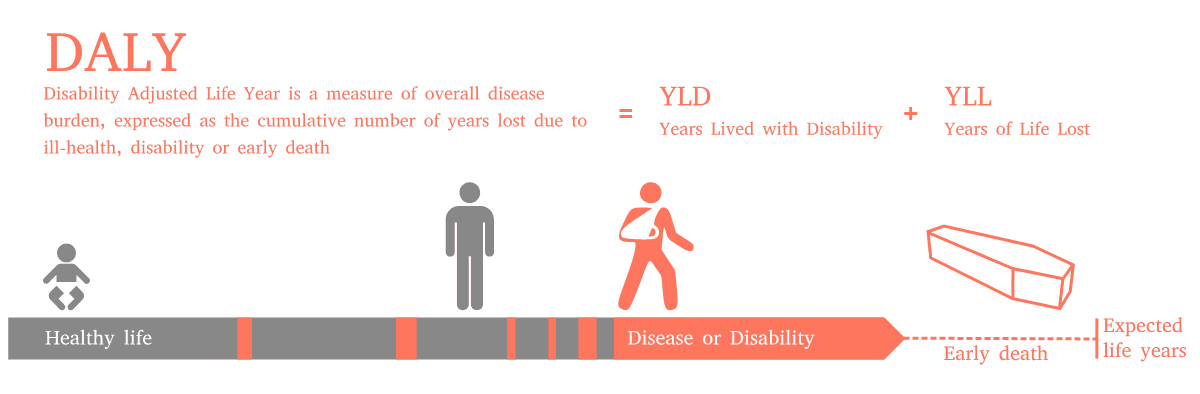
Image source: Wikimedia
While DALYs offer a standardized way to compare different health issues, they have inherent limitations: they yield a single compressed number, involve subjective age-weighting, and face philosophical hurdles when comparing entirely different types of life outcomes.
GiveWell’s Multi-Dimensional Modeling
The research organization GiveWell spends over 70,000 hours annually investigating, analyzing, and modeling charity cost-effectiveness. Instead of blindly relying on standard DALYs, they estimate the marginal impact of specific funding opportunities and apply their own rigorously debated Moral Weights.
GiveWell uses a "doubling of consumption for one person for one year" as a baseline unit of weight (1) to evaluate health interventions against direct cash transfers. For example:
Averting a lifetime of disability (associated with clubfoot): Assigned a weight of 30.
Averting the death of a newborn: Assigned a weight of 84.
Averting the death of a five-year-old child: Assigned a weight of 134.
To ensure these numbers aren't arbitrary, GiveWell constructs its moral weights based on a balanced mix of donor surveys (60%), beneficiary perspective proxies via research by IDinsight (30%), and expert staff opinion proxies (10%).
They then evaluate opportunities against a strict bar for funding (which historically sits around 8x to 10x the impact of just giving cash directly to people living in extreme poverty).
Measuring life satisfaction: The Wellbeing Approach (WELLBYs)
While GiveWell is a gold standard for global health, critics such as the Happier Lives Institute (HLI) point out that traditional health metrics sometimes struggle with compounding uncertainty, or fail to accurately weigh extending a life versus improving the psychological quality of a life.
To solve this, HLI utilizes the WELLBY (Wellbeing-Adjusted Life Year) framework.
WELLBYs = Wellbeing Increase (0-10 scale) x Years the Effect Lasts x Number of People Affected
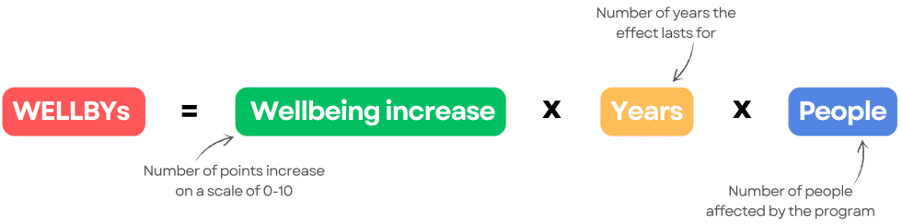
Image source: https://www.happierlivesinstitute.org/report/wellby/
Note: This isn't just an academic exercise. Both the UK and New Zealand Treasuries have adopted WELLBY frameworks for official policy and budget analysis.
By measuring life satisfaction directly, WELLBYs allow us to compare traditional physical health interventions directly against mental health interventions, like group psychotherapy. For instance, HLI's analysis comparing GiveDirectly (lump-sum cash transfers) and StrongMinds (group psychotherapy for depression in low-income countries) yielded striking results:
GiveDirectly: Generates 9 WELLBYs per treatment at a cost of US$1,220 (7.3 WELLBYs per US$1,000).
StrongMinds: Generates 12 WELLBYs per treatment at a cost of US$170 (70 WELLBYs per US$1,000).
Through a pure wellbeing lens, task-shifted psychotherapy can track as up to 9x more cost-effective per dollar than unconditional cash transfers, because alleviating severe depression fundamentally shifts a person’s subjective daily reality.
Giving What We Can: Evaluating the Evaluators
Because organizations like GiveWell and the Happier Lives Institute (HLI) use different methodologies, donors often wonder which framework they should trust. This is where Giving What We Can (GWWC) steps in. Rather than only conducting primary field research, GWWC acts as a meta-evaluator, assessing the charity evaluators themselves to help donors navigate these complex, competing models.
When GWWC analyzes GiveWell and HLI, they look at how each evaluator balances the trade-offs between data certainty and philosophical assumptions:
Evaluating GiveWell: GWWC recognizes GiveWell's incredible strength in data-heavy, evidence-backed global health interventions. However, GWWC also highlights criticisms regarding GiveWell’s "uncertainty problem" and compounding math models, where small adjustments to subjective moral weights or disease prevalence estimates can drastically alter a charity's projected impact.
Evaluating HLI: GWWC looks closely at HLI’s innovative use of wellbeing data (WELLBYs). While GWWC values how HLI captures the internal, lived experiences of beneficiaries beyond just economic or physical health metrics, they also acknowledge the limitations. Subjectivity across different cultures and the unresolved philosophical debate over how to value saving a life versus improving a life mean the wellbeing framework carries its own set of unproven assumptions.
By evaluating the evaluators, GWWC highlights a vital truth: neither GiveWell's wealth-and-health metrics nor HLI's wellbeing metrics are absolute truths. They are mathematically rigorous, deeply considered models, but models are not flawless mirrors of reality.
Rather than viewing data as an infallible monarch, we should view these frameworks as incredibly useful, highly sophisticated guides. They do not give us perfect answers, but they give us significantly better, more rigorous direction than relying on unguided intuition or superficial overhead costs ever could.
The Takeaway for Hong Kong Givers
Models cannot perfectly reflect the real world, and rigorous research produces data, not absolute unchangeable 'facts'. Different frameworks will yield different recommendations depending on whether your moral framework places more weight on saving a child's life from malaria or curing an adult's clinical depression.
But cost-effectiveness analyses do not have to be flawless to be profoundly useful. By prioritizing structured data and moving past shallow concepts like "admin overhead," we can move significantly closer to realizing our true ambition for social impact.
The next time you decide where to direct your charitable dollars, challenge your intuition and ask the bigger question: How much good will this donation actually create?
Note: The research in this post was done by a human, not by AI. AI was used in some places to tidy up the writing.
When we see a social issue that moves us, our natural instinct is to respond with our hearts. We want to help, so we look for a charity that tells a compelling story, or we look at their financial statements to 'make sure their overhead or admin costs are low'. Well-intentioned, caring Hong Kong donors ask these suboptimal questions because they deeply care about making a difference.
However, behavioral research shows that our moral intuitions about charitable impact are frequently wrong. We often suffer from scope insensitivity—our brains struggle to emotionally grasp the difference between saving 10 lives and saving 10,000 lives; they both just feel like "doing good." Because our gut feelings cannot distinguish between an intervention that helps a handful of people and one that transforms an entire community, we need a more objective tool.
When we talk about assigning a cost to an outcome, some may instinctively recoil. But we must remember: the price of saving a life is not the same as the value of a life. Life is invaluable. It is precisely because we value human life immensely that we must look at the price of interventions, so that we can save as many people as possible with our finite resources.
Seeking to maximize measurable impact isn’t cold or clinical; it is a profound type of ambition for impact. It is the recognition that because our charitable resources are strictly limited, we have a responsibility to make them go as far as possible. Data is not a monarch; it is merely a guide, and while perfect data does not exist, striving for better data allows us to make far better-informed decisions than relying on gut feelings or overhead ratios alone.
In this article, we explore how leading international evaluators use Cost-Effectiveness Analysis (CEA) to bypass intuitive biases and uncover where our donations can do the most good.
The Reality of Giving: Impact is "Heavy-Tailed"
In many areas of life, we expect outcomes to follow a standard bell curve—where most charities produce average results, a few do slightly worse, and a few do slightly better. However, data in global health and development reveals that charitable impact is drastically heavy-tailed.
As highlighted by Toby Ord in “The Moral Imperative Towards Cost-Effectiveness”, economic evaluations from the World Bank’s Disease Control Priorities Project (DCP3) indicate that roughly 80% of the benefits are produced by the top 20% of interventions. The difference between an ordinary charity and a highly effective one isn't a minor 10% or 20% improvement; the most effective interventions are often 100x to 1,000x more impactful per dollar spent.
Cost-effectiveness of global health interventions (DCP3)
To find these hyper-impactful opportunities, impact-focused evaluators look at cost-effectiveness through a much wider lens than most people realize. When we talk about cost-effectiveness, we aren't just looking for cheap programmes; we seek to find interventions that are evidence-backed, with depth, durability, and scalability, amongst other features. That is fundamentally what true cost-effectiveness means.
Impact-Focused Charity Evaluation | Traditional Charity Evaluation |
Prioritise Causes: Uses structured frameworks like STN (Scale, Tractability, Neglectedness) to identify high-priority problem areas. | Focuses primarily on which cause area aligns with the giver’s personal or emotional focus. |
Evidence-Based: Focuses on highly effective interventions backed by a strong evidence base, such as Randomized Controlled Trials (RCTs). | Looks broadly at which charities happen to work in a specific cause area. |
Core outcome metrics: Measures what the program actually achieves and compares its cost-effectiveness against other programs. | Weighs easily obtainable metrics more heavily, such as overhead costs, accountability, and financial transparency. |
Depth of Investigation: Conducts deep, exhaustive investigations into a smaller number of highly promising programs. | Provides surface-level ratings for hundreds of charities to ensure they aren't fraudulent. |
Shifting Metrics: From DALYs to Moral Weights
To calculate "good per dollar" accurately, researchers have had to move beyond basic outputs (like the number of blankets distributed) to actual health and life outcomes.
A foundational metric used by global entities like the World Health Organization is the DALY (Disability-Adjusted Life Year), which quantifies the overall disease burden, the cumulative number of years lost due to ill health, disability or early death:
DALY = YLL (Years of Life Lost due to premature mortality) + YLD (Years LIved with Disability/Illness)
Image source: Wikimedia
While DALYs offer a standardized way to compare different health issues, they have inherent limitations: they yield a single compressed number, involve subjective age-weighting, and face philosophical hurdles when comparing entirely different types of life outcomes.
GiveWell’s Multi-Dimensional Modeling
The research organization GiveWell spends over 70,000 hours annually investigating, analyzing, and modeling charity cost-effectiveness. Instead of blindly relying on standard DALYs, they estimate the marginal impact of specific funding opportunities and apply their own rigorously debated Moral Weights.
GiveWell uses a "doubling of consumption for one person for one year" as a baseline unit of weight (1) to evaluate health interventions against direct cash transfers. For example:
Averting a lifetime of disability (associated with clubfoot): Assigned a weight of 30.
Averting the death of a newborn: Assigned a weight of 84.
Averting the death of a five-year-old child: Assigned a weight of 134.
To ensure these numbers aren't arbitrary, GiveWell constructs its moral weights based on a balanced mix of donor surveys (60%), beneficiary perspective proxies via research by IDinsight (30%), and expert staff opinion proxies (10%).
They then evaluate opportunities against a strict bar for funding (which historically sits around 8x to 10x the impact of just giving cash directly to people living in extreme poverty).
Measuring life satisfaction: The Wellbeing Approach (WELLBYs)
While GiveWell is a gold standard for global health, critics such as the Happier Lives Institute (HLI) point out that traditional health metrics sometimes struggle with compounding uncertainty, or fail to accurately weigh extending a life versus improving the psychological quality of a life.
To solve this, HLI utilizes the WELLBY (Wellbeing-Adjusted Life Year) framework.
WELLBYs = Wellbeing Increase (0-10 scale) x Years the Effect Lasts x Number of People Affected
Image source: https://www.happierlivesinstitute.org/report/wellby/
Note: This isn't just an academic exercise. Both the UK and New Zealand Treasuries have adopted WELLBY frameworks for official policy and budget analysis.
By measuring life satisfaction directly, WELLBYs allow us to compare traditional physical health interventions directly against mental health interventions, like group psychotherapy. For instance, HLI's analysis comparing GiveDirectly (lump-sum cash transfers) and StrongMinds (group psychotherapy for depression in low-income countries) yielded striking results:
GiveDirectly: Generates 9 WELLBYs per treatment at a cost of US$1,220 (7.3 WELLBYs per US$1,000).
StrongMinds: Generates 12 WELLBYs per treatment at a cost of US$170 (70 WELLBYs per US$1,000).
Through a pure wellbeing lens, task-shifted psychotherapy can track as up to 9x more cost-effective per dollar than unconditional cash transfers, because alleviating severe depression fundamentally shifts a person’s subjective daily reality.
Giving What We Can: Evaluating the Evaluators
Because organizations like GiveWell and the Happier Lives Institute (HLI) use different methodologies, donors often wonder which framework they should trust. This is where Giving What We Can (GWWC) steps in. Rather than only conducting primary field research, GWWC acts as a meta-evaluator, assessing the charity evaluators themselves to help donors navigate these complex, competing models.
When GWWC analyzes GiveWell and HLI, they look at how each evaluator balances the trade-offs between data certainty and philosophical assumptions:
Evaluating GiveWell: GWWC recognizes GiveWell's incredible strength in data-heavy, evidence-backed global health interventions. However, GWWC also highlights criticisms regarding GiveWell’s "uncertainty problem" and compounding math models, where small adjustments to subjective moral weights or disease prevalence estimates can drastically alter a charity's projected impact.
Evaluating HLI: GWWC looks closely at HLI’s innovative use of wellbeing data (WELLBYs). While GWWC values how HLI captures the internal, lived experiences of beneficiaries beyond just economic or physical health metrics, they also acknowledge the limitations. Subjectivity across different cultures and the unresolved philosophical debate over how to value saving a life versus improving a life mean the wellbeing framework carries its own set of unproven assumptions.
By evaluating the evaluators, GWWC highlights a vital truth: neither GiveWell's wealth-and-health metrics nor HLI's wellbeing metrics are absolute truths. They are mathematically rigorous, deeply considered models, but models are not flawless mirrors of reality.
Rather than viewing data as an infallible monarch, we should view these frameworks as incredibly useful, highly sophisticated guides. They do not give us perfect answers, but they give us significantly better, more rigorous direction than relying on unguided intuition or superficial overhead costs ever could.
The Takeaway for Hong Kong Givers
Models cannot perfectly reflect the real world, and rigorous research produces data, not absolute unchangeable 'facts'. Different frameworks will yield different recommendations depending on whether your moral framework places more weight on saving a child's life from malaria or curing an adult's clinical depression.
But cost-effectiveness analyses do not have to be flawless to be profoundly useful. By prioritizing structured data and moving past shallow concepts like "admin overhead," we can move significantly closer to realizing our true ambition for social impact.
The next time you decide where to direct your charitable dollars, challenge your intuition and ask the bigger question: How much good will this donation actually create?
Note: The research in this post was done by a human, not by AI. AI was used in some places to tidy up the writing.
When we see a social issue that moves us, our natural instinct is to respond with our hearts. We want to help, so we look for a charity that tells a compelling story, or we look at their financial statements to 'make sure their overhead or admin costs are low'. Well-intentioned, caring Hong Kong donors ask these suboptimal questions because they deeply care about making a difference.
However, behavioral research shows that our moral intuitions about charitable impact are frequently wrong. We often suffer from scope insensitivity—our brains struggle to emotionally grasp the difference between saving 10 lives and saving 10,000 lives; they both just feel like "doing good." Because our gut feelings cannot distinguish between an intervention that helps a handful of people and one that transforms an entire community, we need a more objective tool.
When we talk about assigning a cost to an outcome, some may instinctively recoil. But we must remember: the price of saving a life is not the same as the value of a life. Life is invaluable. It is precisely because we value human life immensely that we must look at the price of interventions, so that we can save as many people as possible with our finite resources.
Seeking to maximize measurable impact isn’t cold or clinical; it is a profound type of ambition for impact. It is the recognition that because our charitable resources are strictly limited, we have a responsibility to make them go as far as possible. Data is not a monarch; it is merely a guide, and while perfect data does not exist, striving for better data allows us to make far better-informed decisions than relying on gut feelings or overhead ratios alone.
In this article, we explore how leading international evaluators use Cost-Effectiveness Analysis (CEA) to bypass intuitive biases and uncover where our donations can do the most good.
The Reality of Giving: Impact is "Heavy-Tailed"
In many areas of life, we expect outcomes to follow a standard bell curve—where most charities produce average results, a few do slightly worse, and a few do slightly better. However, data in global health and development reveals that charitable impact is drastically heavy-tailed.
As highlighted by Toby Ord in “The Moral Imperative Towards Cost-Effectiveness”, economic evaluations from the World Bank’s Disease Control Priorities Project (DCP3) indicate that roughly 80% of the benefits are produced by the top 20% of interventions. The difference between an ordinary charity and a highly effective one isn't a minor 10% or 20% improvement; the most effective interventions are often 100x to 1,000x more impactful per dollar spent.
Cost-effectiveness of global health interventions (DCP3)
To find these hyper-impactful opportunities, impact-focused evaluators look at cost-effectiveness through a much wider lens than most people realize. When we talk about cost-effectiveness, we aren't just looking for cheap programmes; we seek to find interventions that are evidence-backed, with depth, durability, and scalability, amongst other features. That is fundamentally what true cost-effectiveness means.
Impact-Focused Charity Evaluation | Traditional Charity Evaluation |
Prioritise Causes: Uses structured frameworks like STN (Scale, Tractability, Neglectedness) to identify high-priority problem areas. | Focuses primarily on which cause area aligns with the giver’s personal or emotional focus. |
Evidence-Based: Focuses on highly effective interventions backed by a strong evidence base, such as Randomized Controlled Trials (RCTs). | Looks broadly at which charities happen to work in a specific cause area. |
Core outcome metrics: Measures what the program actually achieves and compares its cost-effectiveness against other programs. | Weighs easily obtainable metrics more heavily, such as overhead costs, accountability, and financial transparency. |
Depth of Investigation: Conducts deep, exhaustive investigations into a smaller number of highly promising programs. | Provides surface-level ratings for hundreds of charities to ensure they aren't fraudulent. |
Shifting Metrics: From DALYs to Moral Weights
To calculate "good per dollar" accurately, researchers have had to move beyond basic outputs (like the number of blankets distributed) to actual health and life outcomes.
A foundational metric used by global entities like the World Health Organization is the DALY (Disability-Adjusted Life Year), which quantifies the overall disease burden, the cumulative number of years lost due to ill health, disability or early death:
DALY = YLL (Years of Life Lost due to premature mortality) + YLD (Years LIved with Disability/Illness)
Image source: Wikimedia
While DALYs offer a standardized way to compare different health issues, they have inherent limitations: they yield a single compressed number, involve subjective age-weighting, and face philosophical hurdles when comparing entirely different types of life outcomes.
GiveWell’s Multi-Dimensional Modeling
The research organization GiveWell spends over 70,000 hours annually investigating, analyzing, and modeling charity cost-effectiveness. Instead of blindly relying on standard DALYs, they estimate the marginal impact of specific funding opportunities and apply their own rigorously debated Moral Weights.
GiveWell uses a "doubling of consumption for one person for one year" as a baseline unit of weight (1) to evaluate health interventions against direct cash transfers. For example:
Averting a lifetime of disability (associated with clubfoot): Assigned a weight of 30.
Averting the death of a newborn: Assigned a weight of 84.
Averting the death of a five-year-old child: Assigned a weight of 134.
To ensure these numbers aren't arbitrary, GiveWell constructs its moral weights based on a balanced mix of donor surveys (60%), beneficiary perspective proxies via research by IDinsight (30%), and expert staff opinion proxies (10%).
They then evaluate opportunities against a strict bar for funding (which historically sits around 8x to 10x the impact of just giving cash directly to people living in extreme poverty).
Measuring life satisfaction: The Wellbeing Approach (WELLBYs)
While GiveWell is a gold standard for global health, critics such as the Happier Lives Institute (HLI) point out that traditional health metrics sometimes struggle with compounding uncertainty, or fail to accurately weigh extending a life versus improving the psychological quality of a life.
To solve this, HLI utilizes the WELLBY (Wellbeing-Adjusted Life Year) framework.
WELLBYs = Wellbeing Increase (0-10 scale) x Years the Effect Lasts x Number of People Affected
Image source: https://www.happierlivesinstitute.org/report/wellby/
Note: This isn't just an academic exercise. Both the UK and New Zealand Treasuries have adopted WELLBY frameworks for official policy and budget analysis.
By measuring life satisfaction directly, WELLBYs allow us to compare traditional physical health interventions directly against mental health interventions, like group psychotherapy. For instance, HLI's analysis comparing GiveDirectly (lump-sum cash transfers) and StrongMinds (group psychotherapy for depression in low-income countries) yielded striking results:
GiveDirectly: Generates 9 WELLBYs per treatment at a cost of US$1,220 (7.3 WELLBYs per US$1,000).
StrongMinds: Generates 12 WELLBYs per treatment at a cost of US$170 (70 WELLBYs per US$1,000).
Through a pure wellbeing lens, task-shifted psychotherapy can track as up to 9x more cost-effective per dollar than unconditional cash transfers, because alleviating severe depression fundamentally shifts a person’s subjective daily reality.
Giving What We Can: Evaluating the Evaluators
Because organizations like GiveWell and the Happier Lives Institute (HLI) use different methodologies, donors often wonder which framework they should trust. This is where Giving What We Can (GWWC) steps in. Rather than only conducting primary field research, GWWC acts as a meta-evaluator, assessing the charity evaluators themselves to help donors navigate these complex, competing models.
When GWWC analyzes GiveWell and HLI, they look at how each evaluator balances the trade-offs between data certainty and philosophical assumptions:
Evaluating GiveWell: GWWC recognizes GiveWell's incredible strength in data-heavy, evidence-backed global health interventions. However, GWWC also highlights criticisms regarding GiveWell’s "uncertainty problem" and compounding math models, where small adjustments to subjective moral weights or disease prevalence estimates can drastically alter a charity's projected impact.
Evaluating HLI: GWWC looks closely at HLI’s innovative use of wellbeing data (WELLBYs). While GWWC values how HLI captures the internal, lived experiences of beneficiaries beyond just economic or physical health metrics, they also acknowledge the limitations. Subjectivity across different cultures and the unresolved philosophical debate over how to value saving a life versus improving a life mean the wellbeing framework carries its own set of unproven assumptions.
By evaluating the evaluators, GWWC highlights a vital truth: neither GiveWell's wealth-and-health metrics nor HLI's wellbeing metrics are absolute truths. They are mathematically rigorous, deeply considered models, but models are not flawless mirrors of reality.
Rather than viewing data as an infallible monarch, we should view these frameworks as incredibly useful, highly sophisticated guides. They do not give us perfect answers, but they give us significantly better, more rigorous direction than relying on unguided intuition or superficial overhead costs ever could.
The Takeaway for Hong Kong Givers
Models cannot perfectly reflect the real world, and rigorous research produces data, not absolute unchangeable 'facts'. Different frameworks will yield different recommendations depending on whether your moral framework places more weight on saving a child's life from malaria or curing an adult's clinical depression.
But cost-effectiveness analyses do not have to be flawless to be profoundly useful. By prioritizing structured data and moving past shallow concepts like "admin overhead," we can move significantly closer to realizing our true ambition for social impact.
The next time you decide where to direct your charitable dollars, challenge your intuition and ask the bigger question: How much good will this donation actually create?
While perfect data does not exist, striving for better data allows us to make far better-informed decisions than relying on gut feelings or overhead ratios alone.
While perfect data does not exist, striving for better data allows us to make far better-informed decisions than relying on gut feelings or overhead ratios alone.
While perfect data does not exist, striving for better data allows us to make far better-informed decisions than relying on gut feelings or overhead ratios alone.
Related Blog
Related Blog
Related Blog


