
The best interventions are many times more effective than others
The best interventions are many times more effective than others
The best interventions are many times more effective than others

Introduction
Much research has shown that the most effective projects/charities can be 50 times more impactful than average charities, and 1000 times more impactful than the least.
Unfortunately, many donors vastly underestimate the difference between “good” and “great” charities, which explains why many top charities remain underfunded.
Impact of global health interventions
The World Bank compiled a list of 93 global health treatments and preventative measures, and calculated the cost-effectiveness of each intervention. They measure cost-effectiveness in how many years of healthy life that intervention gets for a $1000 USD investment.
This graph shows the interventions with positive outcomes from least cost-effective to the most cost effective. According to the analysis, the best global health interventions in their list are about 50 times more effective at improving lives than the average intervention. And the best ones are over 1000 times more effective than the least effective.
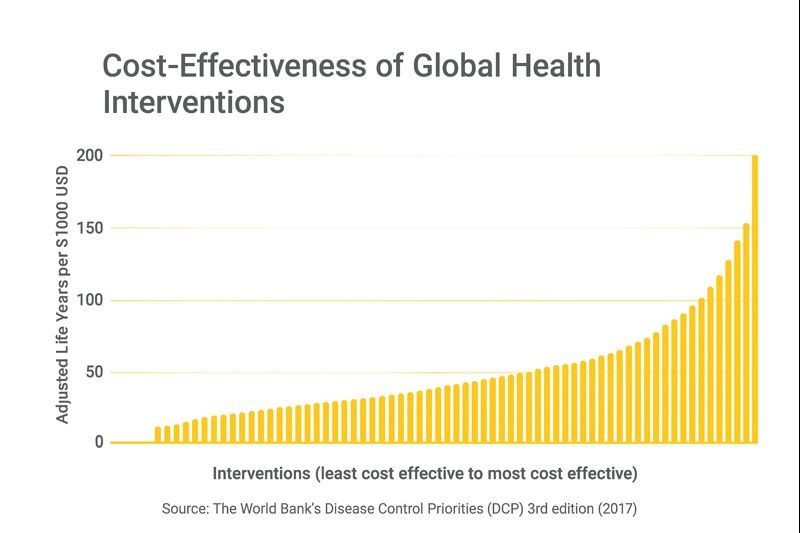
So that means if you donate to a world health charity that is merely average, you might be helping only a single person with your donation, when you could be helping fifty people by the same amount! This means that where you choose to donate matters a lot. In fact, where you donate can matter much more than the amount you donate! If you donate to the very best charities, you might be doing more to help people than a multimillionaire who donates a huge amount of money.
The cost of saving a life
GiveWell estimates that on average, it costs their top charities around US$3000-5000 to save one life.
Having said this, it is important to remember that this is the cost of saving a life, not the value of a life, which is immeasurable. It is exactly because we value life so much that means we must take the question of cost effectiveness seriously. It matters so much where we invest our donations because we are making decisions that have real consequences on the lives of others.
Introduction
Much research has shown that the most effective projects/charities can be 50 times more impactful than average charities, and 1000 times more impactful than the least.
Unfortunately, many donors vastly underestimate the difference between “good” and “great” charities, which explains why many top charities remain underfunded.
Impact of global health interventions
The World Bank compiled a list of 93 global health treatments and preventative measures, and calculated the cost-effectiveness of each intervention. They measure cost-effectiveness in how many years of healthy life that intervention gets for a $1000 USD investment.
This graph shows the interventions with positive outcomes from least cost-effective to the most cost effective. According to the analysis, the best global health interventions in their list are about 50 times more effective at improving lives than the average intervention. And the best ones are over 1000 times more effective than the least effective.
So that means if you donate to a world health charity that is merely average, you might be helping only a single person with your donation, when you could be helping fifty people by the same amount! This means that where you choose to donate matters a lot. In fact, where you donate can matter much more than the amount you donate! If you donate to the very best charities, you might be doing more to help people than a multimillionaire who donates a huge amount of money.
The cost of saving a life
GiveWell estimates that on average, it costs their top charities around US$3000-5000 to save one life.
Having said this, it is important to remember that this is the cost of saving a life, not the value of a life, which is immeasurable. It is exactly because we value life so much that means we must take the question of cost effectiveness seriously. It matters so much where we invest our donations because we are making decisions that have real consequences on the lives of others.
Introduction
Much research has shown that the most effective projects/charities can be 50 times more impactful than average charities, and 1000 times more impactful than the least.
Unfortunately, many donors vastly underestimate the difference between “good” and “great” charities, which explains why many top charities remain underfunded.
Impact of global health interventions
The World Bank compiled a list of 93 global health treatments and preventative measures, and calculated the cost-effectiveness of each intervention. They measure cost-effectiveness in how many years of healthy life that intervention gets for a $1000 USD investment.
This graph shows the interventions with positive outcomes from least cost-effective to the most cost effective. According to the analysis, the best global health interventions in their list are about 50 times more effective at improving lives than the average intervention. And the best ones are over 1000 times more effective than the least effective.
So that means if you donate to a world health charity that is merely average, you might be helping only a single person with your donation, when you could be helping fifty people by the same amount! This means that where you choose to donate matters a lot. In fact, where you donate can matter much more than the amount you donate! If you donate to the very best charities, you might be doing more to help people than a multimillionaire who donates a huge amount of money.
The cost of saving a life
GiveWell estimates that on average, it costs their top charities around US$3000-5000 to save one life.
Having said this, it is important to remember that this is the cost of saving a life, not the value of a life, which is immeasurable. It is exactly because we value life so much that means we must take the question of cost effectiveness seriously. It matters so much where we invest our donations because we are making decisions that have real consequences on the lives of others.
The best interventions are many times more effective than others
The best interventions are many times more effective than others
The best interventions are many times more effective than others
Related Blog
Related Blog
Related Blog


